
Dam project
Engineers Tested Rough River Dam’s Future Outlet Works More Than 200 Times Before Construction
Before the new control tower, tunnel and stilling basin take shape at Rough River, engineers tested the design on a massive physical model in Mississippi.
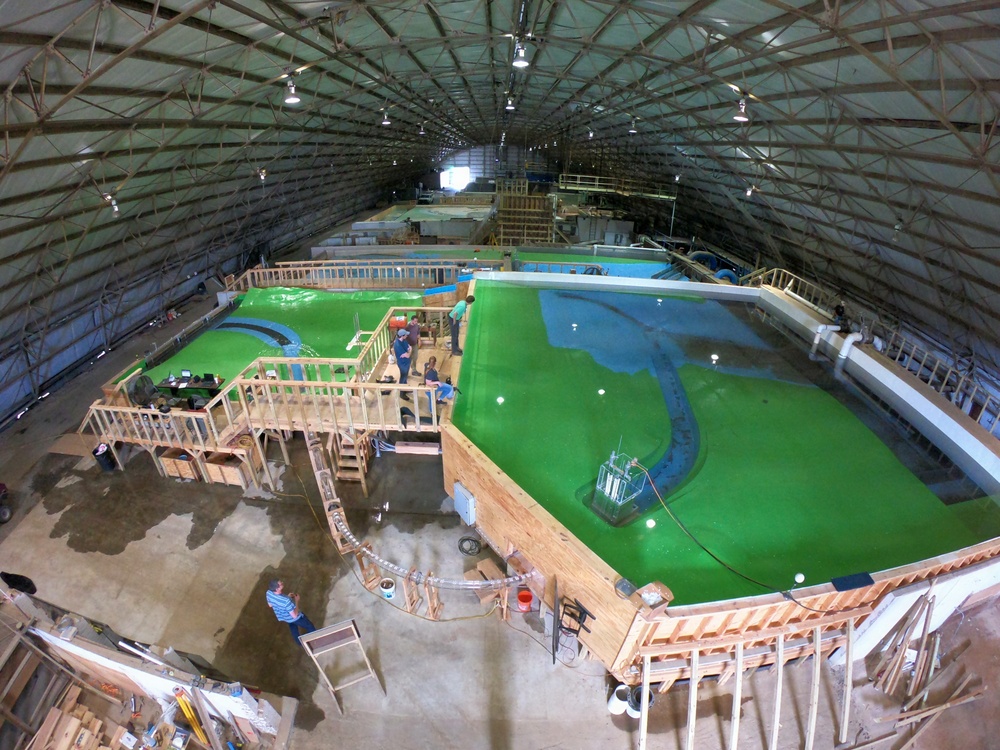
Photo courtesy of the U.S. Army Engineer Research and Development Center (ERDC), via USACE Louisville District / DVIDS. VIRIN: 260921-A-GI410-3274. View original image
The appearance of U.S. Department of War (DoW) visual information does not imply or constitute DoW endorsement.
Editorial standards
Before the new outlet works at Rough River Dam begin taking shape in concrete and rock, engineers already spent years studying how the system should behave once water starts moving through it.
One of the tools they used was surprisingly hands-on: a 57-foot-wide, 100-foot-long physical model built at the U.S. Army Engineer Research and Development Center in Vicksburg, Mississippi.
The U.S. Army Corps of Engineers says engineers ran more than 200 tests on that model to see how the future outlet works would perform under everything from routine lake releases to rare, extreme flood events.
For a project this large, that physical model gave engineers a chance to test the design before the real structures are built at Rough River.
A 100-Foot Model of the Future Outlet Works
The model was created as part of the design work for the new outlet system planned in Phase 2 of the Rough River Dam Safety Modification Project.
According to USACE, engineers used it to study the new tunnel alignment, the retreat channel downstream of the outlet, and how the entire system would behave during different release conditions.
The model measured approximately 57 feet wide and 100 feet long.
That size allowed engineers to physically observe water moving through the proposed design rather than relying only on calculations or computer simulations.
Why Build a Physical Model in the Age of Supercomputers?
Computer modeling is an important part of modern dam design, but water does not always behave as neatly as a computer equation.
USACE engineers explained that computer models necessarily make assumptions about turbulence and fluid behavior. A physical scale model lets the team compare those calculations with water moving through an actual three-dimensional structure.
That is especially important inside an outlet tunnel.
At lower releases, water moves through the tunnel with an open surface. As the gates open farther and flows increase, the tunnel can fill completely and become pressurized.
That transition changes the hydraulic forces acting on the tunnel and other structures, which makes it an important part of the design to test carefully.
More Than 200 Test Runs
USACE says the Rough River team completed more than 200 test runs on the physical model.
Those tests included routine operational releases as well as rare, extreme flood scenarios.
The goal was not simply to prove that water would move through the system. Engineers were looking at how the proposed outlet works would perform across a wide range of operating conditions and whether the physical results matched the calculations used during design.
The Corps says that combination of computer modeling and physical testing gave the project team greater confidence in the final design before construction.
How This Connects to the Work Happening at Rough River
Phase 2 construction at Rough River Dam is already underway.
The new outlet works will eventually include a new control tower, a tunnel through the left side of the dam area, a stilling basin and the downstream retreat channel.
Once that system is operating, later phases of the project include construction of the full-depth cutoff wall through the dam and underlying karst foundation. Kentucky 79 is also planned to return to the top of the dam near the end of the project.
The Louisville District says this is its first new dam outlet-works design since Taylorsville Lake in the 1970s.
That makes the Rough River project unusual even within the Corps of Engineers: an entirely new outlet system being designed and built at an operating reservoir.
What This Means for Rough River Residents
Most people around the lake will never see the physical model in Mississippi, but the structures tested there are the same ones that will eventually control releases from Rough River Lake.
As construction progresses, the control tower, tunnel, stilling basin and retreat channel will become some of the most visible pieces of Phase 2.
The physical-model testing is one part of the work that happened long before those structures began appearing at the dam.
For residents and lake users, it helps explain why a project of this size takes years of design, testing and construction before the new system can take over from the original outlet works.
TARR will continue following the project as those features begin taking shape at Rough River.
Sources
Go to the record