
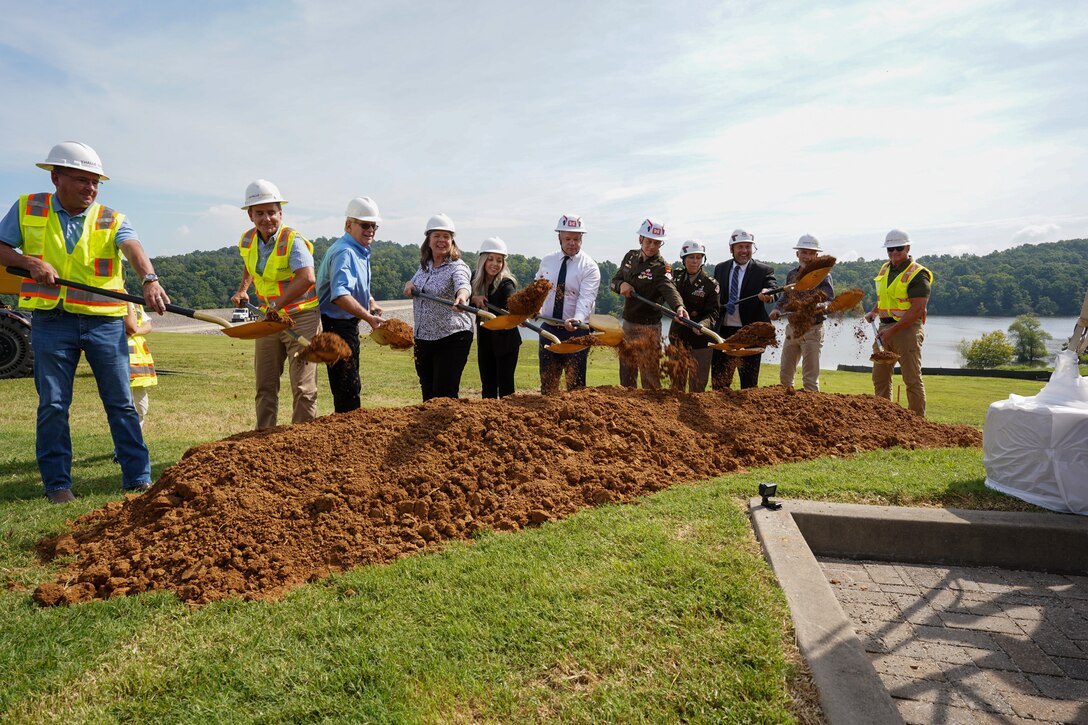
July 21 was the groundbreaking ceremony for Phase 2 of the Rough River Dam Safety Modification Project. Phase 2 construction is officially underway. Over the next six to eight years, we are going to watch this dam go through the biggest change it has ever seen.
If you have driven by lately, you have probably already noticed things starting to change. Today I want to catch you up on what has happened so far, what you are seeing now, and what comes next.
What Has Happened So Far?
Construction began in March 2026, several months before the July groundbreaking ceremony.
By the time of the ceremony, visitors could already see trees cleared on the lodge side of the emergency spillway, new access roads, staging areas, and construction trailers. Those trailers will serve as contractor offices and project support space.
You have probably also noticed work on the bridge over the emergency spillway. That is a separate project led by the Kentucky Transportation Cabinet. It is happening at the same time as the dam project, but it is not part of the Corps of Engineers work.
So, What Comes Next?
Now that the site is ready, this is where the major construction begins.
One of the first major features people will see is a cofferdam.
A cofferdam is basically a temporary dam around the job site. Its job is to keep water out of a construction area.
Think about where the new control tower is going. Right now, some of that area is underwater. Crews cannot excavate, pour concrete, or build the new structures while the site is sitting at the bottom of the lake.
Before that work can begin, crews have to create a dry work area. They will build a temporary cofferdam around the future control tower site, pump the water out of the enclosed area, and turn that part of the lake into a dry construction site.
Building an Entirely New Outlet System
Once the work area is dry, crews can start building the new outlet system.
Near the emergency spillway, crews will build a brand-new control tower to replace the tower that has been operating since the dam entered service in 1959. They will also excavate a new approach channel so lake water can reach it.
From there, water will travel through a new outlet tunnel through the left abutment of the dam. When it comes out the other end, it will enter a new stilling basin. The stilling basin slows the water and reduces its energy before it continues downstream.
The water will then flow through a new retreat channel and rejoin the Rough River tailwater below the dam.
When all of this is finished, Rough River Dam will have an entirely new path for releasing water.
Blasting
Another part of the work people will notice is blasting.
Crews need to blast through rock to excavate the tunnel and other structures for the outlet system. Blasting is tentatively scheduled to begin in spring 2027 and will include work on the upstream and downstream sides of the left abutment.
The Corps says property owners within the blasting zones will be notified and coordinated with before blasting activities begin.
Looking Ahead
The new outlet system is only one part of Phase 2. After it is operating, crews will permanently retire the existing control tower and outlet works. They will also build a full-depth cutoff wall through the dam to reduce seepage through the foundation. The Corps says that wall will extend roughly 75 to 180 feet below the top of the dam.
The final work includes returning Kentucky 79 to the top of the dam. None of those later phases can move forward in sequence until the new outlet system is ready to manage releases from the lake.
For now, keep an eye on the left side of the dam near the emergency spillway. That is where the cofferdam, new control tower, tunnel, stilling basin, and retreat channel will take shape.
I will keep bringing you updates as each new phase kicks off.
If you want to dig into the project yourself, the Army Corps of Engineers has planning documents and slide decks posted with the Phase 2 procurement records on SAM.gov. Those records include technical material that was not part of the last public meeting.
Primary sources